Description
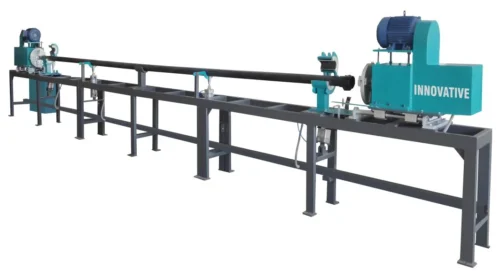
Automatic HDPE Pipe Coupler Friction Welding Machine
An Automatic HDPE Pipe Coupler Friction Welding Machine joins HDPE pipes using a special coupler. First, it rotates the pipe or coupler at a fixed speed. Next, it applies pressure. As a result, the HDPE material softens. This forms a strong and reliable bond.
Unlike manual welding, the machine controls alignment, heat, pressure, and cooling automatically. Therefore, it produces uniform and leak-proof joints every time. Moreover, it reduces operator effort. Also, it improves consistency and overall productivity.
How Does the Machine Work?
Pipe and Coupler Loading
First, the operator places the HDPE pipes and coupler into the clamps. Then, the machine holds them firmly in place.
Automatic Alignment
Next, the system aligns the pipe ends and coupler. This ensures proper positioning. As a result, it prevents weak joints.
Friction Heating
Then, the machine rotates the pipe or coupler. Friction creates heat at the contact area. Consequently, the HDPE material softens evenly.
Fusion Stage
After rotation stops, the machine applies axial pressure. This fuses the softened material together.
Cooling Under Pressure
Meanwhile, the machine keeps pressure during cooling. Therefore, the joint becomes strong and stable.
Final Inspection
Finally, sensors check the weld. Operators can also perform a visual inspection. This ensures the joint meets quality standards.
Why Is This Machine Important in Modern Industry?
Modern industries need fast, strong, and repeatable pipe joints. However, manual welding often causes poor alignment and uneven heating. Because of this, joint quality may suffer.
Automatic coupler welding machines solve these problems. They help industries by:
-
Increasing production speed
-
Improving joint consistency
-
Reducing labor dependence
-
Minimizing material waste
-
Improving workplace safety
As a result, companies achieve better quality and lower operating costs.
Types and Variants of HDPE Pipe Coupler Welding Machines
1. Semi-Automatic Coupler Welding Machine
This type suits small workshops. It needs some manual control. However, it requires a lower investment.
2. Fully Automatic Coupler Welding Machine
This model works best for mass production. It uses PLC control. Therefore, it delivers high speed and consistent results.
3. Portable Coupler Welding Machine
This version is ideal for on-site work. It is lightweight and easy to move.
4. Heavy-Duty Industrial Models
These machines handle large-diameter pipes. They are commonly used in utilities and infrastructure projects.
Each type fits different production needs and work conditions.
Standard Industry-Level Technical Specifications
-
Pipe Diameter Range: 20 mm to 400 mm (customizable)
-
Compatible Materials: HDPE, PP, PPR
-
Welding Method: Friction-based coupler fusion
-
Rotation Speed: Adjustable, 50–300 RPM
-
Clamping Force: Hydraulic or servo controlled
-
Power Supply: 3 Phase, 380–415 V, 50 Hz
-
Control System: PLC with HMI
-
Automation Level: Semi-automatic or fully automatic
Industries and Applications
This machine is widely used in:
-
Water supply pipelines
-
Gas distribution networks
-
Irrigation systems
-
Chemical and process plants
-
Infrastructure and construction projects
-
Industrial manufacturing units
Therefore, these industries depend on strong and reliable coupler joints.
How to Choose the Right Machine
Buyers should consider the following points:
-
Pipe diameter and coupler size
-
Type of material used
-
Daily production volume
-
Required automation level
-
Available budget
-
Work location, such as factory or site
At Innovative Mechatronics, we also offer customized solutions to meet specific needs.
Safety Standards and Operator Protection
The machine includes:
Applicable Standards:
ISO 9001, ISO 21307, EN 12201, ASTM F2620
These standards ensure safe and compliant operation.
Why Choose Innovative Mechatronics?
At Innovative Mechatronics, we design machines that focus on accuracy and durability. Our automatic HDPE pipe coupler friction welding machines improve productivity and joint quality. Moreover, they offer long service life and reliable performance for industrial use.
Frequently Asked Questions (F&Q)
Q1. What is an Automatic HDPE Pipe Coupler Friction Welding Machine?
It joins HDPE pipes using controlled friction and pressure. As a result, it creates strong and leak-proof joints.
Q2. How does this machine work?
First, it aligns the pipes. Then, it generates heat through rotation. After that, it applies pressure and allows cooling.
Q3. Which materials can it weld?
Mainly HDPE pipes. In addition, some models also weld PP and PPR.
Q4. Is it suitable for on-site use?
Yes. Portable models support easy on-site welding.
Q5. How long does one welding cycle take?
Usually, it takes 5 to 15 minutes. However, the time depends on pipe size.
Q6. What are the main benefits?
It improves quality, saves time, reduces errors, and lowers labor costs.
Q7. Does it require skilled operators?
Yes. Basic training helps ensure safe operation and consistent results.
Q8. Which industries use this machine?
Water supply, gas, irrigation, chemical, and infrastructure industries.
Q9. How is it better than manual welding?
It controls heat and pressure precisely. Therefore, joints are stronger and more uniform.
Q10. What maintenance is required?
Regular lubrication, sensor checks, and clamp inspection keep the machine running well.